
Evaluating Mountain Property
Kent Gunnufson · June 2026
Buying mountain property is one of the most rewarding decisions a person can make — and one of the easiest ways to get burned if you don't know what you're looking at. After decades of living, building, and investing in Colorado's high country, I've seen buyers fall in love with a view and overlook everything that actually determines whether a property works for them. The view is the last thing you need to evaluate. Everything else comes first.
Access: The Question Nobody Asks
The single most important factor in mountain property is access, and most buyers don't ask nearly enough questions about it. A paved county road is one thing. A private road maintained by a homeowners association is another. A two-track dirt road that crosses three other private parcels to reach yours is something else entirely.
Find out who maintains the road and who pays for it. In Colorado, many mountain roads are county-maintained only to a certain point, after which maintenance becomes the responsibility of whoever lives up the road. Snow removal alone can run thousands of dollars a winter. If the road is shared, get the road maintenance agreement in writing before you close — not after.
Also ask about the road in spring. Many mountain roads that look perfectly fine in summer become impassable during mud season, typically April and May. If you're planning to use the property year-round, drive it in the worst conditions you can find before you buy.
Water Rights and Water Supply
Colorado water law is unlike anything most buyers have encountered. Water rights are separate from land ownership, and the fact that a stream runs through your property does not mean you have the right to use it. In Colorado, water rights are governed by the doctrine of prior appropriation — first in time, first in right — and those rights are adjudicated by the state.
If the property has a well, get a well test that measures both flow rate and water quality. A flow rate below 1 gallon per minute is marginal for a full-time residence. Find out when the well was drilled, what depth it reaches, and whether neighboring wells have had any issues. In some mountain areas, wells have been known to go dry during drought years.
If the property relies on a spring, understand that springs can be seasonal and are not guaranteed. A spring that flows well in June may be a trickle by September. Have it tested during the driest part of the year, not the wettest.
Septic Systems at Altitude
Mountain properties rarely connect to municipal sewer systems. That means a septic system, and septic systems at altitude come with their own set of complications. Rocky soils, shallow bedrock, and steep terrain all affect how a system can be designed and where it can be placed.
Have the existing system inspected and pumped before closing. Find out when it was last serviced and whether it has ever failed. If you're buying raw land and planning to build, have a percolation test done before you commit — some mountain parcels simply cannot support a conventional septic system, and the alternatives (engineered systems, mound systems, aerobic treatment units) can add $30,000 to $60,000 to your construction costs.
Snow Load and Structural Considerations
At 9,000 feet and above, snow loads are not a minor consideration — they are a primary engineering factor. Colorado's high country can receive 300 to 500 inches of snow in a heavy year, and wet spring snow in particular can be extraordinarily heavy. A roof that handles 40 pounds per square foot may not be adequate at elevation.
When evaluating an existing structure, look at the roof pitch, the span of the rafters, and the age of the building. Flat or low-pitched roofs are a red flag at altitude. Look for any signs of sagging, cracking at the ridge, or doors and windows that no longer close properly — these can all indicate structural stress from snow loads over the years.
If you're planning to build, work with an engineer who has specific experience in high-altitude construction. The building codes in mountain counties reflect local conditions, but a good engineer will often exceed code minimums for snow load, wind, and seismic considerations.
Income Potential: Short-Term Rentals
One of the most common questions I hear from buyers is whether the property can generate rental income. In Colorado's mountain resort communities, the short-term rental market has been strong for years, and a well-located property can generate meaningful income. But the numbers require honest analysis.
Start with occupancy rates, not gross revenue. A property that generates $80,000 in gross rental income sounds impressive until you subtract the platform fees (typically 15–20% for Airbnb or VRBO), the property management fee (another 20–30% if you're not managing it yourself), cleaning costs, maintenance, utilities, HOA fees, property taxes, and insurance. Net income on a short-term rental is often 40–50% of gross revenue in a well-run operation, and less if the property has high maintenance demands.
Location within the market matters enormously. A property that is ski-in/ski-out or within walking distance of a resort village will command premium rates and high occupancy. A property that requires a car to reach the lifts will compete in a much more crowded middle tier. Study the comparable rentals in the immediate area — not the county, not the zip code, but the specific neighborhood — and look at actual occupancy data, which platforms like AirDNA can provide.
Also investigate local regulations before you buy. Many Colorado mountain towns have enacted short-term rental licensing requirements, caps on the number of permits issued, and in some cases outright bans in certain zones. Breckenridge, Telluride, Steamboat Springs, and other resort communities have all tightened their STR regulations in recent years. Verify that the property is eligible for a short-term rental license before you factor that income into your purchase decision.
Long-Term Rental Income
Long-term rentals — twelve-month leases to year-round residents — offer more predictable income and lower operating costs than short-term rentals, but the yields are typically lower in resort markets where property values are high relative to long-term rents. In a community like Breckenridge or Vail, a property that sells for $900,000 might rent long-term for $2,800 to $3,500 per month, producing a gross yield of under 5%. After expenses, the net yield is often 2–3%.
That said, long-term rentals have real advantages. Tenant turnover is lower, wear and tear is more predictable, and you're not managing a hospitality operation. For buyers who want income without the complexity of short-term management, a long-term rental in a community with strong workforce housing demand — Silverthorne, Frisco, Dillon — can be a solid investment.
The Hidden Costs of Mountain Ownership
Every mountain property owner eventually learns that the cost of ownership is higher than they anticipated. Heating costs at altitude are substantial — propane is the most common fuel in areas without natural gas service, and propane prices in mountain communities can run 30–50% higher than in the Front Range. A well-insulated home at 9,500 feet can still consume 800 to 1,200 gallons of propane in a cold winter.
Maintenance costs are also elevated. The UV intensity at altitude degrades exterior paint, stains, and sealants faster than at lower elevations. Roofs need more frequent inspection. Decks and exterior wood require regular treatment. Pipes freeze. Wildlife — bears, squirrels, porcupines — can cause damage that surprises first-time mountain homeowners.
Budget conservatively. A rule of thumb I've used for years: plan to spend 1.5% to 2% of the property's value annually on maintenance and capital improvements. On a $600,000 property, that's $9,000 to $12,000 per year. It sounds like a lot until the first time you replace a well pump, a septic system, or a roof.
What Makes a Mountain Property Worth Buying
After all of that, why buy? Because mountain property, bought thoughtfully, is one of the most satisfying investments a person can make — not just financially, but in terms of how it shapes a life. The access to public lands, the quality of the air, the pace of the seasons, the community of people who choose to live at altitude — these are things that don't show up on a balance sheet but matter enormously.
Buy a property with good bones: solid access, reliable water, a sound structure, and a location that will hold its value through market cycles. Understand the income potential honestly, without inflating the numbers. Budget for the real costs of ownership. And then enjoy what you've built — because there is nothing quite like owning a piece of the Colorado high country.
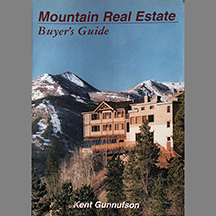
Mountain Real Estate Buyer's Guide
Rocky Mountain Self-Portrait
Tracking the Snowshoe Itinerant
Bumming Colorado's Ski Country
Grandma Builds an Earthship
Share this article